For China’s 250 million individual investors, AI is helping them make money from one of the world’s most volatile stock markets

When Ryan Lei has an investment idea, he no longer has to spend days writing code and trawling through historical data to corroborate it.
The 27-year-old quantitative trader in Hong Kong now delegates much of the grunt work to artificial intelligence. For a recent bet tied to a major technology initial public offering, Lei deployed Futu’s AI agents to collect data on similar listings over the past decade and parse their post-debut performances. The AI-assisted research informed a short position that eventually earned him several thousand US dollars.
AI can rapidly complete workloads that used to take days or even weeks, according to Lei, who has nine years of investing experience and co-manages a seven-person proprietary quantitative trading team.
Lei’s case highlights the extent to which AI could change the behaviour of traders and even reshape the landscape of the financial and asset-management industries.
In the US, brokerages such as Robinhood and Webull are integrating AI into their tools to help clients, mostly individual investors, buy and sell stocks.
In Hong Kong, Futu Securities – one of the city’s largest online brokers – launched an agentic feature called “expert mode” in July, allowing clients to conduct investment research and place orders for stocks, options and exchange-traded funds using natural-language instructions.
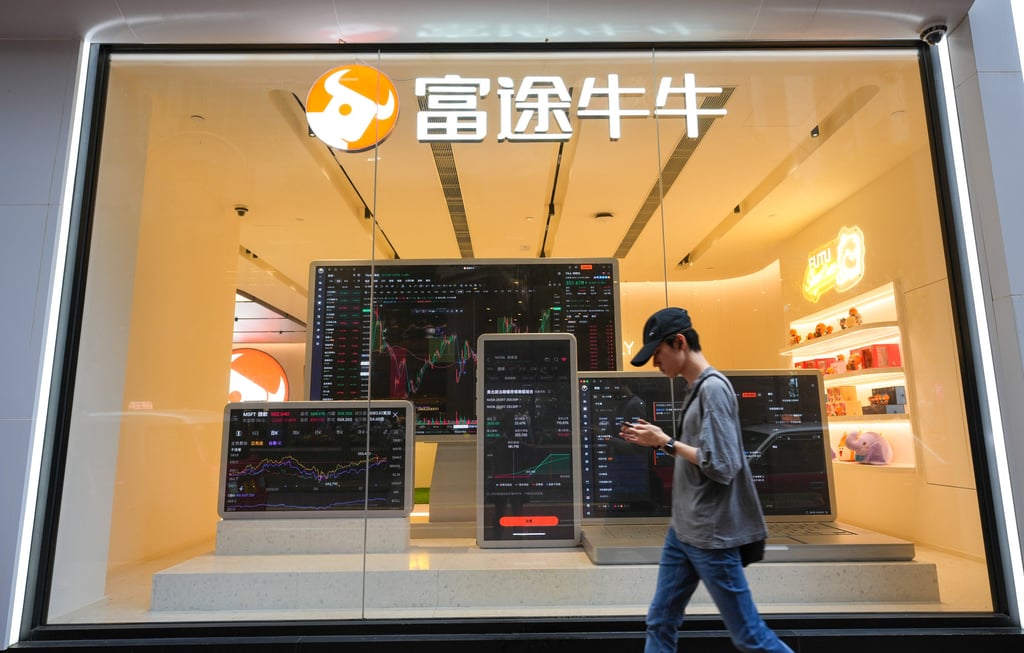
Daily queries to Futu’s AI tools jumped about 50 per cent month on month in August after the introduction of the new feature, according to the company
More than half of user queries now focus on individual-stock analysis, including company fundamentals, earnings and technical trends, while derivatives and quantitative strategies have emerged as the second largest use cases, the company said.
The path is more cautious in mainland China, where retail investors mostly use AI tools for information gathering, data analysis and stock-price monitoring, rather than directly making or executing investment decisions.
That is because mainland regulations prohibit stock recommendations by individuals and entities not licensed by the securities regulator.
When the South China Morning Post asked for stock recommendations from Doubao, the popular AI chatbot run by ByteDance, it answered that investors should be held accountable for their own decisions, and only offered general advice such as “using idle money” and assessing stocks by “corporate fundamentals”.
Still, AI is rapidly being adopted by the investment and financial community. More than 80 per cent of mainland Chinese brokerages have deployed AI in their trading apps, helping investors glean and parse data, according to domestic media. Leading brokerages are also pressing ahead with integrating AI into research and development, replacing the manual work of information collection, data processing and translations of research reports.
For China’s 250 million individual investors, AI can help them make money from one of the world’s most volatile stock markets.
Jacky Jia, a 48-year-old investor in Shanghai, has realised a return of about 5 per cent from stock picking so far this year. His frequently-used AI tools are Doubao and Baidu’s Ernie chatbot, which he uses to analyse financial results and business prospects of target companies, as well as conduct technical analysis on where stocks would meet resistance.
“AI can be wrong sometimes and you need to make decisions on your own,” Jia said. “But it’s great at gathering information. I will keep using it for stock trading in the future.”
Jia’s portfolio, which is concentrated in tech stocks, managed to beat the benchmark CSI 300 Index that has declined more than 2 per cent this year.
For Lei, the quantitative trader, AI has become embedded in almost every stage of his team’s workflow, from collecting and analysing data to generating strategies and writing code. He estimated that AI now helped produce about 99 per cent of the code used by his team.
Still, there is one task that remains in human hands. While Lei’s team uses AI for research and strategy development, it leaves the final execution of trades to a conventional rule-based quantitative trading system.
“Quantitative investing needs to be rigorous, while AI still has a certain degree of randomness,” Lei said.